


In a typical year, foodborne outbreaks recognized by the CDC make about 15,000 Americans sick (Knurick, 2026). This summer, a single parasite passed that number in four months.
Between May 1 and August 31, 2026, the CDC confirmed 20,996 cases of cyclosporiasis, 1,161 hospitalizations, and two deaths, nearly 18x the 1,180 cases over the same window in 2025. More than half trace back to one source: shredded iceberg lettuce from Taylor Farms de Mexico, which the FDA classified as a Class I recall, its most serious designation.
For Supply Change Capital, the outbreak confirmed a thesis we have invested behind since day one: the systems that keep our food safe are reactive, under-resourced, and overdue for modernization, and technology can change that.
More risk, fewer safeguards
In all of 2024, the CDC’s 62 multi-state outbreak investigations accounted for 2,605 illnesses. This year’s Cyclospora season produced roughly 8x as many, just as the public safety net got thinner:
Fewer people watching. Since 2025, the CDC has cut roughly 2,900 positions and USDA’s Food Safety and Inspection Service more than 900, about 30% and 12% of current staff. The CDC team tracking food parasites went from 11 scientists to three (Knurick).
Less research and surveillance. Three USDA Cyclospora research projects were halted mid-outbreak, and the CDC scaled back FoodNet, its foodborne disease surveillance system.
Slower modernization. Compliance with the FDA’s Food Traceability Rule (FSMA 204) has been pushed to 2028.
When fewer federal inspectors and epidemiologists are catching problems, growers, processors, distributors, and retailers have to catch more of them on their own, and earlier.
The cost of finding out too late
Food-borne illness costs the US an estimated $74.7 billion a year. For industry, each recall costs roughly $10M in direct costs, and by that measure 2026 is one of the most expensive years of the last decade, trailing only 2016 to 2018, when FSMA’s Preventive Controls rules took effect.
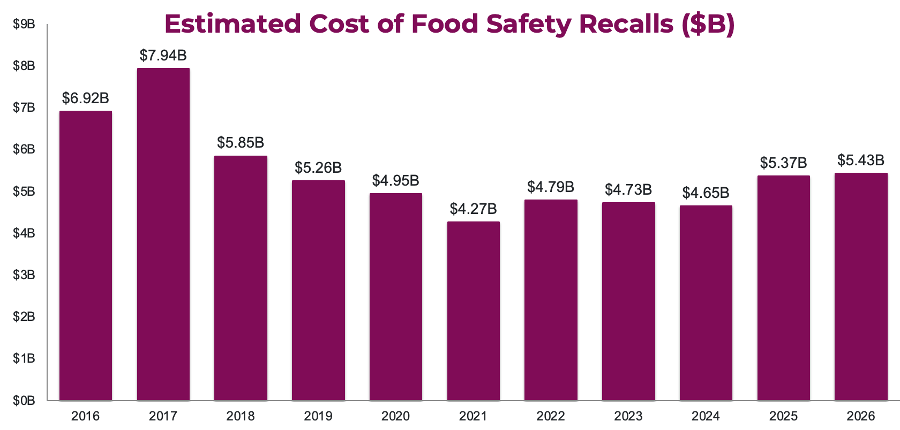
The indirect costs are larger. Taco Bell traffic fell nearly 30% after the outbreak was linked to the chain and was still 12.2% below 2025 from July through September. Grocery lettuce sales fell 9% to 20% in July, roughly $29.7M to $66.1M in lost revenue in one month, much of it borne by growers who did nothing wrong. A recall is the most expensive way to learn if something went wrong.
From reactive to proactive
Today’s system works backward: someone gets sick, a lab confirms it, epidemiologists connect cases, investigators trace the food to a farm, and only then does a recall go out. Each step takes days to weeks while the contaminated product keeps moving. Technology can shorten that chain or skip it: testing at the point of production, digital records that turn tracebacks from weeks into hours, software that catches compliance gaps before product ships, and safer inputs that reduce hazards at the source.
Our food safety bets, from field to shelf
Food safety issues can occur at any link in the food value chain: farm and production, processing and packaging, transportation, retail and food service, and the home kitchen. No single fix closes every gap, which is why we invest across the chain.
Food safety has been a core SCC investment area since inception. Since 2022, we have deployed over $5M across five companies in food safety and compliance, 13% of our portfolio companies and 19% of initial capital deployed across Funds I & II. Additional details on those companies below:
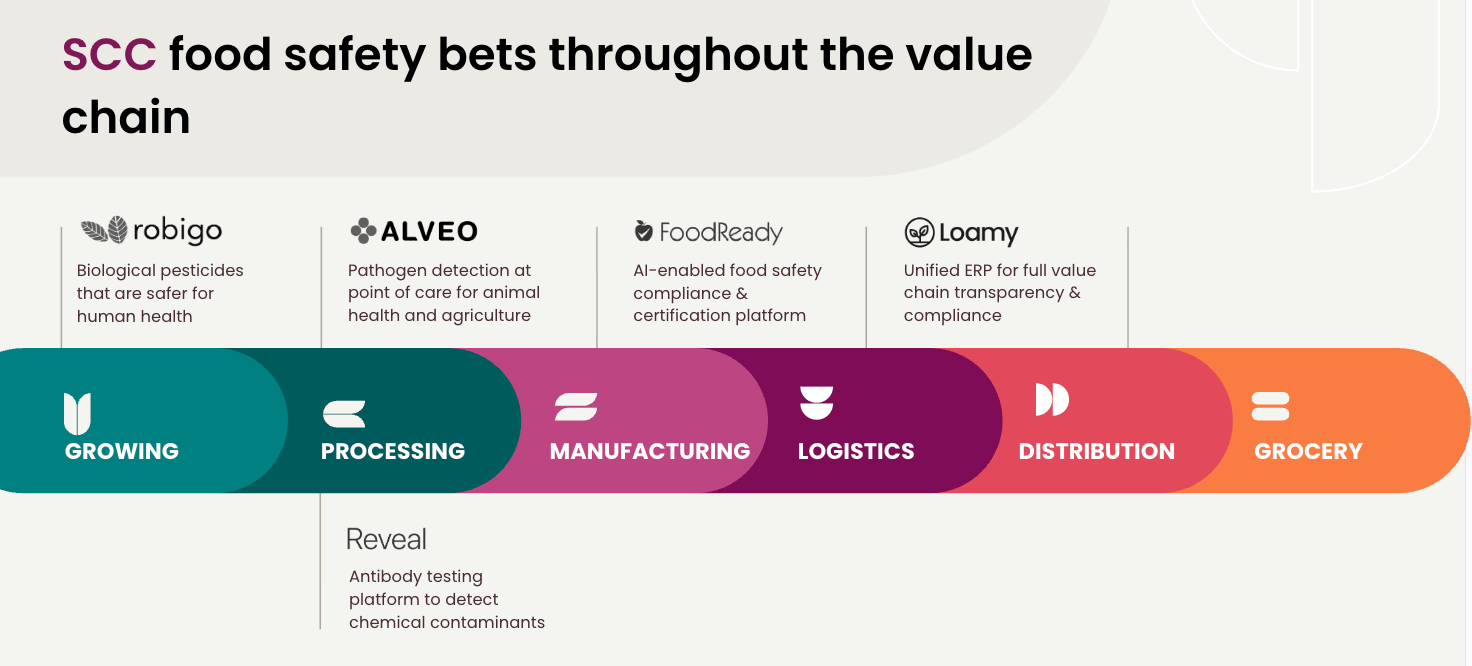
Robigo | Growing. Safer crop protection, starting at the source.
Engineered biologicals that outperform synthetic chemistries, so growers can cut chemical residues without sacrificing yield or margins.
Alveo Technologies | Processing. A molecular lab that fits in your palm.
Lab-quality pathogen detection in under an hour, anywhere, starting with avian influenza in poultry and livestock, so outbreaks are caught on site before they spread.
Reveal Foods | Processing. Contaminant results in 20 minutes, not 3 days.
Rapid antibody tests for antibiotics, heavy metals, pesticides, and mycotoxins, making it practical for producers and grocers to test more often and closer to the consumer.
FoodReady | Manufacturing. Compliance that catches problems before they ship.
AI-enabled software and expert consulting that help manufacturers achieve GMP, GFSI, SQF, BRC, and FDA/USDA compliance, replacing binders and spreadsheets with automated workflows.
Loamy | Logistics and distribution. Traceability from field to loading dock.
A unified ERP for growers, packers, and distributors, including leafy greens operations in California’s Central Valley, that answers “where did this come from, and where did it go?” in hours, not weeks.
This opportunity is not going away
The outbreak will end; the conditions behind it will not. Supply chains are long, the federal backstop is shrinking, and the cost of a miss is concrete and rising, which pushes responsibility and budget toward industry. Meanwhile, point-of-use testing, AI-enabled compliance, and cloud traceability are now affordable for mid-sized operators, not just the largest players.
Founders are responding. Through September 22, 2026, we tracked 91 food safety and compliance deals, already 18% more than the 77 deals in the category we saw in the full year of 2025 (Source: SCC’s internal deal database). We expect technology to keep creating opportunities to reduce the risk of foodborne illness, and we are especially interested in:
Faster, more cost competitive detection of pathogens and chemical contaminants
Traceability infrastructure that turns tracebacks from weeks into hours
Compliance and quality automation for mid-market operators
Predictive tools that flag where risk is likely to emerge next
If you are building a safer food system, we would love to hear from you. Share your company or idea here.